
Client Background
In 2009, we were a small but ambitious software studio. One of our early clients ran a well-known local footwear brand in Haryana, offering competitively priced shoes across a handful of towns. The business wanted to scale by appointing distributors in multiple cities, and its growth depended on trustworthy local outlets, simple billing, and fast movement of stock. But managing inventory, pricing, and tax displays across several independent distributor locations had become unwieldy as the business planned to expand from five distributors to many more.
We took this project personally. The client needed a practical, resilient, and easy-to-use software system that could manage billing and inventory at multiple locations, reconcile tax-inclusive MRP with itemized reporting, and produce a wide range of operational reports for both central management and distributed staff. It was the kind of challenge that called for more than just code — it needed careful thinking, patient consulting, and a genuine understanding of how the business actually worked day to day.
The Challenge
The retail-chain’s core challenge combined operational scale with regulatory and accounting precision:
- Multi-location independence: Each distributor/store needed its own billing and inventory, yet central management required consolidated visibility.
- Tax-inclusive MRP: The MRP printed on footwear boxes included all taxes. Bills and internal reports, however, needed to display tax components and net prices separately using reverse tax calculations.
- Reporting complexity: The business required many reports — stock movement, aging, distributor-wise sales, margins, returns, and tax summaries — all accurate and timely.
- Limited resources: As a small development effort, we had to design, code, deploy, and train staff with minimal overhead and no online training options.
- Reliability & maintainability: The solution needed to run on available hosting and be maintainable with PHP 5.6 and MySQL, and integrate with the client’s existing workflows.
Why Existing Methods Were Failing
The retail-chain’s existing processes relied heavily on manual ledger entries, inconsistent spreadsheets, and basic cash-register receipts. These approaches failed for several reasons:
- Error-prone calculations: Manual tax and reverse tax calculations led to discrepancies between MRP, net prices, and tax reports.
- Lack of central control: Without a centralized view, stock transfers, overstocks, and stockouts could not be managed proactively.
- Slow reporting: Generating consolidated reports required manual aggregation across distributors and stores.
- Limited audit trail: Tracking sales, returns, and distributor behavior was difficult, making irregularities hard to detect.
- Scalability limits: Processes that worked for five distributors would not scale to dozens or hundreds without automation.
Our Analysis
We began with a tightly focused analysis phase that emphasized operational workflows and pain points rather than hypothetical features. This is where the real craftsmanship of software development shows itself — not in flashy features, but in the discipline of listening carefully before writing a single line of code.
Key findings:
- Every store must operate autonomously for daily billing yet sync critical data to a central system on scheduled intervals.
- MRP on labels could not be changed; therefore every sale must compute the tax back from MRP to produce compliant invoices and reports.
- Distributors required role-based access with minimal learning curve, so the UI and workflows had to mirror existing paper-based steps.
- Reporting and auditability were crucial for the owner to monitor distributor and retail-chain performance and spot irregular activities.
- The system should be modular, allowing re-use across multiple businesses and later conversion into a multi-business, multi-store SaaS model.
Solution We Proposed
We proposed a distribution management system focused on three pillars: autonomy, accuracy, and visibility.
- Multi-store architecture: Each store/distributor would run its own billing and inventory instance with a synchronized central database for consolidated reporting.
- Reverse tax calculation engine: Implement a robust routine to extract tax amounts from tax-inclusive MRPs and display item price, tax, and net amounts on bills and reports.
- Role-based workflows: Simple, role-focused screens for cashiers, store managers, and central admins to minimize training needs.
- Comprehensive reporting module: Pre-built reports for sales, stock movement, tax summaries, and exception alerts (like negative stocks or out-of-sync stores).
- Lightweight deployment: Build using widely-supported, cost-effective technologies (PHP 5.6 and MySQL) to match client hosting and skills.
- Training and support plan: On-site training sessions, printed manuals, and continuous 24×7 follow-up support during early adoption and beyond.
Every decision in this phase was made in close consultation with the client — not simply executing a brief, but actively offering ideas that would help the business grow further than it had originally imagined.
Technology Used
Given the constraints and hosting environment of 2009–2010, we selected pragmatic technologies:
- Backend: PHP 5.6 — chosen for wide hosting availability and familiarity.
- Database: MySQL — reliable relational storage for transactional data and reporting queries.
- Frontend: JavaScript, HTML/CSS — straightforward interfaces optimized for low training overhead.
- Hosting: Shared VPS/host plans common at the time — chosen for cost-efficiency.
- Tools: MySQL stored procedures and optimized queries to support complex reports; basic cron-driven synchronization for multi-location data aggregation.
Features Implemented
The system included the following essential features, each one carefully engineered by minds who understood both the technology and the business it served:
- Store-level billing: Fast POS-like billing screens capturing items, quantity, size/variant, and printing invoices with itemized tax breakdown (reverse-calculated).
- Inventory management: Real-time stock ledger per store, support for transfers, adjustments, and goods received notes.
- Reverse tax calculation: Algorithm to split MRP into tax and base price components across multiple tax slabs.
- Consolidated reporting: Central dashboard aggregating distributor and retail-chain performance, stock positions, and tax summaries.
- User roles and permissions: Distinct access levels for cashiers, store managers, distributors, and admins.
- Audit trail: Transaction logs for bills, returns, and stock adjustments to provide traceability.
- Backup and recovery: Regular database backups and export/import features for offline reconciliation.
- Localized UI: Simple language and labels matched to the client’s operating style to reduce onboarding time.
Business Results
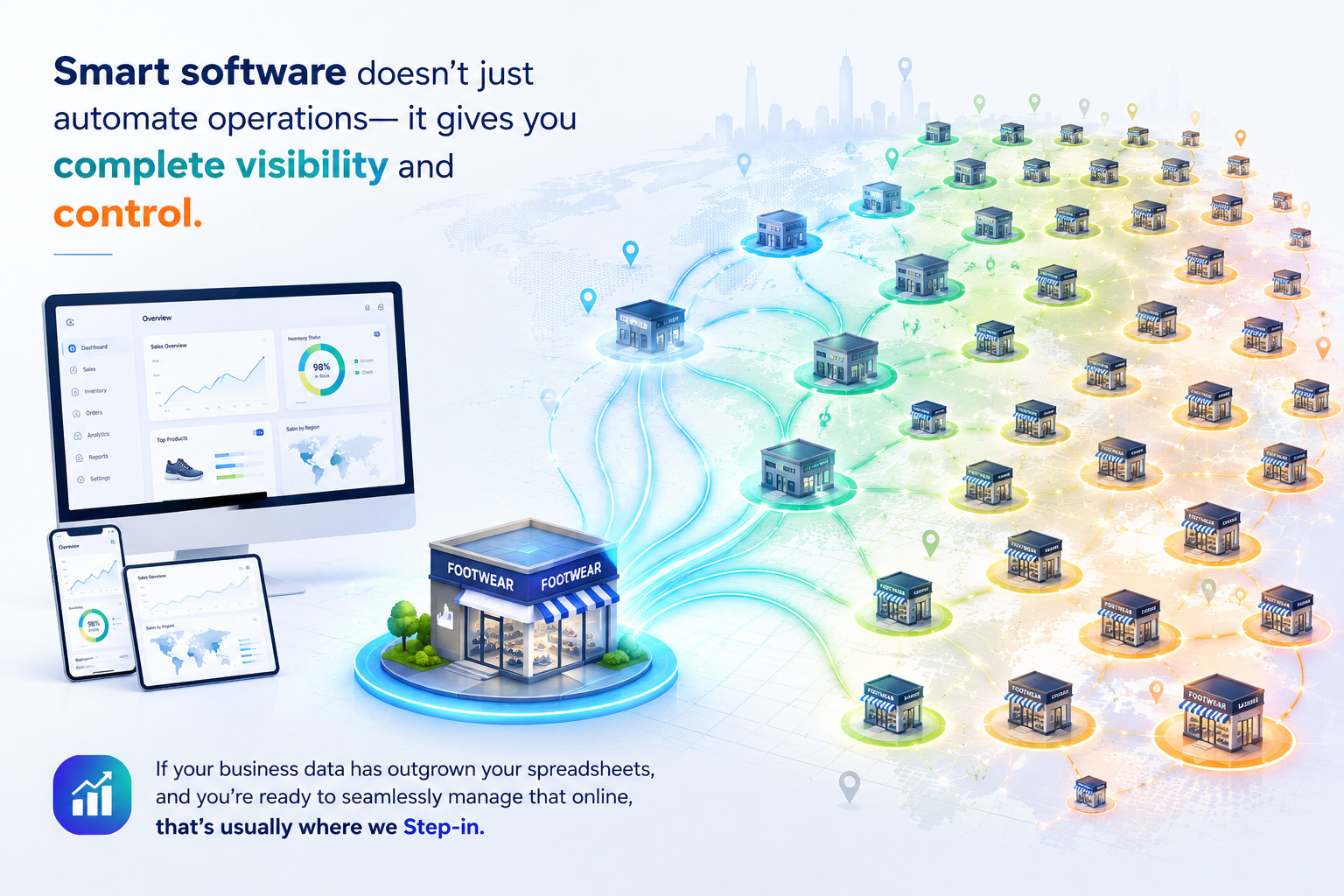
The software did exactly what it was designed to do. It scaled with the business — from 5 distributors to 45, and from no retail outlets to more than 500 retail-chain locations in just two years. Billing errors dropped, operations became faster, and management finally had real-time visibility across the entire distribution network.

- Faster billing, fewer errors: Reverse tax automation eliminated manual calculation errors and aligned printed invoices with regulatory requirements.
- Expanded reach: The distribution footprint grew nearly ninefold at the distributor level, and the retail-chain network grew from zero to 500+ outlets within two years — a scale that would have been unmanageable on manual processes.
- Improved visibility: Centralized reports allowed the owner to monitor distributor and retail-chain sales, stock levels, and margins more clearly than ever before.
- Lower training overhead: Intuitive screens and on-site training meant staff adapted quickly; the working product was delivered and users were trained within three months.
- Sustained support: Continuous updates and round-the-clock support kept the system stable over several years, enabling routine business operations without frequent downtime.
Software, when built with genuine expertise, is always an asset. It gives a business everything it needs — accuracy, visibility, and support that never sleeps. But despite these gains, the business later encountered a challenge no software could have prevented: when a majority of distributors and retail-chain partners acted against the interests of the business, weak ethics, misaligned incentives, and the cunning nature of a few individuals at the top brought the empire down. This was never a failure of the technology — the system had done its job faithfully, right up to the end. It was, instead, a reminder that even the smartest software cannot substitute for integrity in the people who run a business.
 (+91) 980-3069-555” – Email: [email protected]
Lessons Learned
From this project we distilled several enduring lessons — technical and managerial:
- Build for human workflows: Software should map to how people actually work, not to idealized processes that users will resist.
- Visibility is necessary but not sufficient: Central reporting reveals anomalies, but internal controls, ethics, and legal frameworks are needed to act on them.
- Keep tax logic transparent: Tax-inclusive pricing needs deterministic reverse-calculation routines and clear audit trails to maintain trust and compliance.
- Design for scale early: Even small projects benefit from modular architecture so future pivots (like becoming multi-business SaaS) are feasible.
- Train on-site when remote is impossible: Early adoption succeeds faster when users get hands-on, contextual training.
- Governance matters: Software can deter, detect, and document irregularities, but governance policies and partner vetting are vital to prevent collapse — no dashboard can fix what weak character breaks.
How Similar Businesses Can Benefit
Footwear wholesalers, distributors, and small retail chains can gain immediate value by implementing a system like the one we designed:
- Reduce invoice discrepancies by automating reverse tax calculations for tax-inclusive MRPs.
- Preserve local operational autonomy while gaining consolidated management insights.
- Scale distribution quickly without proportionally increasing administrative effort.
- Build an audit trail to support compliance, tax filing, and dispute resolution.
- Convert on-premise installations into a multi-business SaaS platform when growth demands centralized control across brands or geographies.
“Good software reflects real-world workflows — and real-world workflows demand clarity, not complexity. We built a system that made daily work simple, gave the owner visibility, and left a clear audit trail. Software, made by smart minds who genuinely care about a client’s growth, can empower a business forever. But governance must walk alongside it, because software alone cannot manage the ethics of the people entrusted to run the business.”
— Sharat Bharadwaj, Founder & Sr. Consultant, RiAcube Software Hub
(+91) 980-3069-555” – Email: [email protected]
Frequently Asked Questions
What problem was solved for the footwear retail-chain?
We designed and implemented a distribution management system that supported multi-store billing, inventory control, reverse tax calculation for MRP-inclusive pricing, and consolidated reporting across distributors and retail outlets.
How did the software handle tax-inclusive MRP pricing?
The system used a reverse tax calculation engine to split MRP into base price and tax components, displaying both on invoices and generating correct tax summaries for reporting.
What technologies were used to build the system?
The initial system used PHP 5.6 for backend logic, MySQL for the database, and JavaScript/HTML for the frontend; hosted on cost-effective shared hosting available at the time.
How long did development and deployment take?
Development took roughly two months, testing and bug fixing about 15 days, followed by deployment and on-site training — delivered in roughly three months from project start.
Could the system support dozens of distributors and hundreds of retail outlets?
Yes; the architecture supported store-level autonomy with centralized synchronization and reporting. Within two years, the business expanded from 5 to 45 distributors and from zero to more than 500 retail outlets.
Was ongoing support provided?
Yes. Continuous updates and 24×7 support were provided throughout the system’s operational life, ensuring stability and incremental improvements.
Can modern businesses use the same approach today?
Absolutely. The core principles — autonomous store operations, reverse tax logic, consolidated reporting, and audit trails — remain relevant. Today’s implementations would use more current stacks and cloud hosting for scalability.
How did the solution improve reporting and oversight?
Centralized dashboards and reports provided owner-level visibility into distributor and retail sales, stock positions, margins, and exceptions, enabling quicker decision-making and anomaly detection.
What limitations did the system have?
It relied on the governance and vetting of distributors and retail partners to prevent unlawful activities. Technically it was tied to older stacks (PHP 5.6), so modern migration is advisable for long-term scalability.
Is the platform suitable for multiple businesses?
Yes. After this experience, the platform was restructured into a multi-business, multi-store model to support multiple brands and business units.
How can a footwear wholesaler implement similar controls fast?
Start with automating billing and tax calculations, deploy store-level inventory ledgers, implement consolidated reporting, and schedule on-site training. Prioritize audit trails and role-based access.
What are the top risks to watch for during distributor and retail-chain expansion?
Weak governance, inadequate vetting, absence of audit trails, and lack of legal contracts or monitoring can create operational and legal risks that software alone cannot eliminate — no matter how smart or well-built that software is.