
Why Agentic AI Projects Fail and How Multi-Agent Systems Deliver Real Business Value
Most companies didn’t fail at AI because the technology couldn’t perform. They failed because they pointed a powerful new capability at a broken process and expected the process to fix itself.
That’s the uncomfortable truth sitting underneath one of the most talked-about predictions in enterprise technology this year: more than 40% of agentic AI projects will be canceled by the end of 2027. Not paused. Not scaled back. Canceled — after the budget was spent, the pilot ran, and the demo impressed everyone in the room.
If your business already tried a chatbot — for customer support, internal FAQs, or a Slack assistant — and the results were “fine, but not transformative,” you’re not alone, and you’re not behind. You were simply working with an earlier generation of the technology. The conversation in 2026 has moved from “can AI answer a question” to “can AI complete a multi-step piece of work, correctly, without someone babysitting it.” That shift has a name: Agentic AI. And when several of these agents work together, it’s called a Multi-Agent System (MAS).
This guide explains what that actually means in plain terms, why the failure rate is so high, how multi-agent systems are structured, and where businesses are already seeing real, measurable returns.
The Business Problem Comes First
Before getting into the technology, it’s worth naming the problems that are actually driving this conversation inside most companies right now:
- Rising software development costs — every new feature request competes for the same stretched engineering team.
- Repetitive, manual work eating up skilled employees’ time — reconciling orders, chasing approvals, re-keying data between systems that don’t talk to each other.
- Customer experience gaps — support tickets that sit for days, disputes that take a human three system logins to resolve, personalization that stops at “Hi [First Name].”
- Forecasting blind spots — supply chain and inventory decisions still made on spreadsheets and gut feel, one quarter behind reality.
These are the problems agentic AI is actually built to solve. The technology is only interesting because of what it does to these specific, expensive, everyday headaches — not because it’s novel.
What “Agentic AI” Actually Means (Without the Hype)
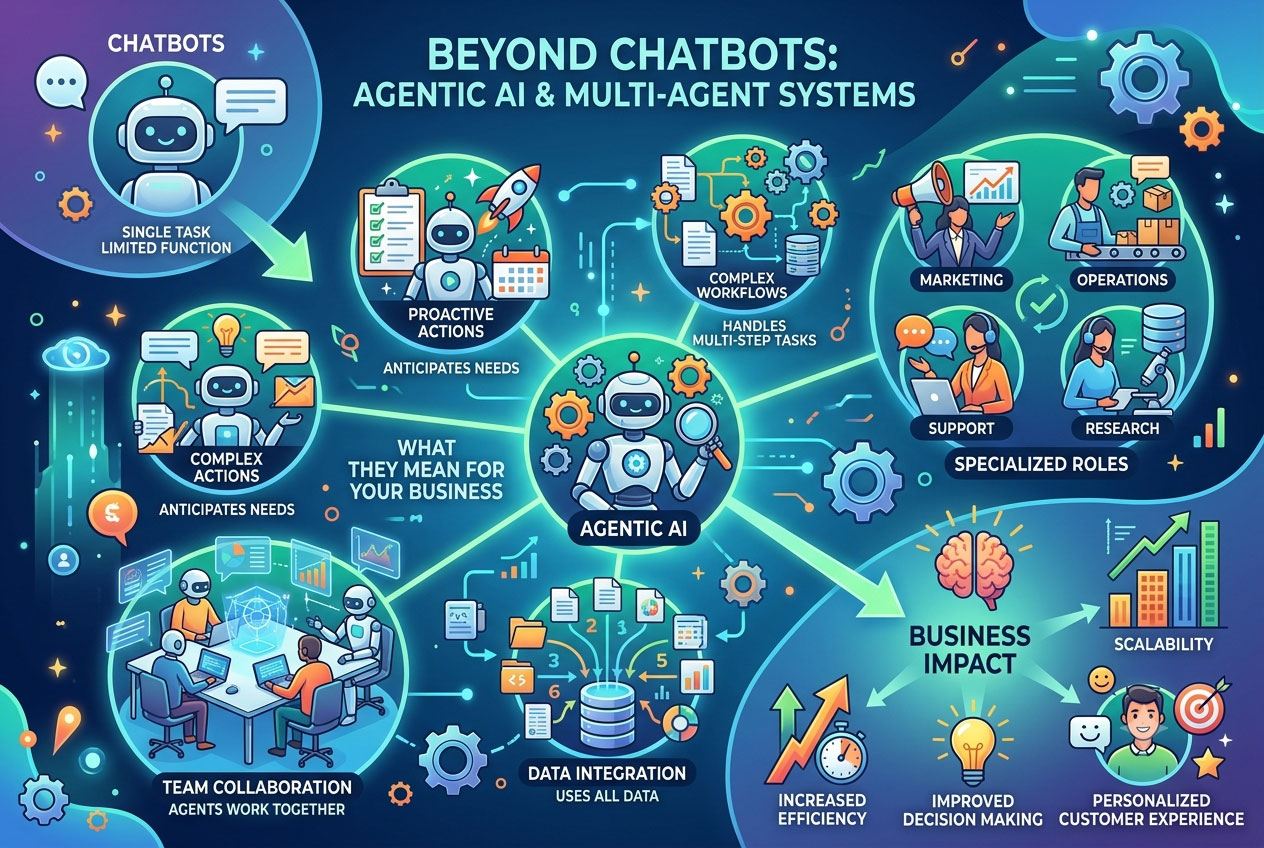
A standard AI chatbot works like a very well-read employee who can only answer the phone. You ask a question, it responds, and then it waits. It has no memory of what it did five minutes ago unless you remind it, and it can’t take an action on your behalf — it can’t actually place the order, update the record, or notify the vendor.
An AI agent is different in three specific ways:
- It can take actions, not just generate text — placing an order, updating a database, sending an email, calling another piece of software.
- It can plan multiple steps toward a goal, not just respond to a single prompt.
- It can operate with a degree of autonomy inside defined guardrails, checking its own work and adjusting course, rather than stopping after every step to ask a human “what next?”
Industry analysts describe this as the difference between a system that augments a workflow and one that automates it end-to-end. As one semiconductor executive put it in a recent industry discussion, agentic AI functions less like a search box and more like a coordinator living inside your systems — accepting a goal, gathering what it needs, and producing an outcome with minimal hand-holding.
That distinction matters, because a lot of what’s currently marketed as “agentic AI” isn’t. Analysts have flagged a pattern called “agent washing” — vendors relabeling ordinary chatbots and robotic process automation (RPA) tools as agentic without adding any real autonomy. Of the thousands of vendors currently using the word “agentic” in their marketing, independent research suggests only a small fraction — roughly 130 — offer genuinely autonomous capabilities. That’s a useful filter to apply the next time a vendor pitches you: ask them exactly what decision the system makes on its own, and what happens when it’s wrong.
Why 40% of Agentic AI Projects Are Predicted to Fail
Here’s the part every business leader evaluating this technology needs to sit with: the failure isn’t primarily a technology problem. It’s a process and expectations problem.
Gartner’s research points to three interconnected causes:
1. Escalating, hidden costs.
Teams budget for the visible line items — development time, cloud compute, API usage — and miss the costs that only surface after the pilot ends: ongoing monitoring, exception-handling, retraining, and the human oversight layer that autonomous systems still require. Independent analysis has found these hidden costs frequently balloon two to three times beyond the original estimate.
2. Unclear business value.
Many projects are greenlit because a competitor announced something similar, not because there’s a measurable outcome attached — a specific hours-saved figure, error-rate reduction, or revenue target. Without that target, there’s no way to know if the project succeeded, and “no clear win” quietly becomes “cancel it.”
3. Automating a broken process instead of redesigning it.
This is the pattern worth remembering above all others: companies take an existing manual workflow — often one that’s already inefficient, undocumented, or full of workarounds — and simply point an AI agent at it, expecting the mess to sort itself out. It doesn’t. An agent layered on top of a broken approval chain just automates the bottleneck faster. The organizations landing in the successful 60% are the ones willing to redesign the underlying workflow first, then apply the agent to the new, cleaner version of it.
Research from MIT Sloan Management Review and Boston Consulting Group, surveying more than 2,100 organizations, found agentic AI adoption has reached roughly 35% in just two years — faster than any prior wave of AI adoption — yet most implementations remain stuck in what researchers call “pilot purgatory.” Deloitte’s own research went further, finding that only about 14% of organizations currently have agentic solutions genuinely ready for production, and roughly 11% are actively running them at scale. The gap between an impressive demo and a system that survives contact with real customers, real data, and real edge cases is where most projects quietly die.
The practical takeaway: before you approve an agentic AI project, ask “what manual process are we redesigning?” — not just “what are we automating?”
The Concept of Multi-Agent Systems: A Simple Analogy
Once a business goes beyond a single-purpose agent, the next stage is a Multi-Agent System (MAS) — several specialized agents, each with a narrow job, coordinating on a shared goal the same way a project team does.
Think of how a software development team actually works:
- A Project Manager breaks a big goal (“launch the new checkout feature”) into smaller tasks, sets priorities, and tracks what’s done.
- A Developer takes each task and writes the code.
- A QA tester checks the developer’s work against requirements, flags bugs, and sends work back if it doesn’t meet the bar.
A multi-agent AI system mirrors this structure almost exactly:
- A “Project Manager” agent receives the overall goal and breaks it into a task sequence.
- A “Developer” agent executes each task — writing code, drafting a document, querying a database.
- A “QA” agent independently reviews the output against the original requirement before it’s marked complete, and routes it back for correction if it isn’t.
No single agent needs to be a generalist that does everything. Each one is narrow, specialized, and — importantly — auditable, because you can see exactly which agent produced which output and why. This modular structure is also why multi-agent systems tend to be more reliable than one giant, do-everything agent: a narrow agent making a narrow decision is easier to test, monitor, and correct than a single system trying to hold an entire complex workflow in its head at once.
This same “specialist team” structure is what’s being applied well beyond software development — into supply chain operations, customer service, financial operations, and marketing, which brings us to where the real ROI is showing up.
Tangible ROI: Where Businesses Are Actually Seeing Returns
Two examples illustrate what this looks like once it moves past the pilot stage.
Manufacturing: Demand Forecasting → Automatic Supplier Ordering
Picture a mid-sized manufacturing firm that currently forecasts demand in a spreadsheet, updated weekly by a planner who’s also handling four other responsibilities. Orders to suppliers go out roughly on schedule, with padding added “just in case” — tying up working capital in excess inventory, or worse, running short during a demand spike.
A multi-agent setup here typically looks like:
- A Forecasting agent continuously ingests sales history, seasonality, and external signals (market trends, even weather data for relevant categories) to produce a rolling demand forecast — updated daily instead of weekly.
- A Procurement agent compares that forecast against current inventory and supplier lead times, and generates a draft purchase order when stock is projected to fall below a threshold.
- An Approval agent (or a human-in-the-loop checkpoint for orders above a certain dollar value) reviews and releases the order automatically for routine, low-risk purchases, while flagging unusual or high-value orders for a human buyer’s sign-off.
The measurable outcomes companies report from this kind of setup: meaningfully reduced excess inventory carrying costs, fewer stockouts during demand spikes, and hours of manual reconciliation work returned to the planning team each week — without removing human judgment from the decisions that actually warrant it.
E-Commerce: Automated, Hyper-Personalized Dispute Resolution
Now picture an e-commerce operation handling a steady stream of “item not as described,” refund, and delivery-dispute tickets. Today, a single dispute might involve a support agent manually pulling up the order history, checking the shipping carrier’s tracking data, reviewing the return policy for that specific product category, and drafting a response — a process that can take 15–20 minutes per ticket even for a straightforward case.
A multi-agent system built for this workflow typically includes:
- An Intake/Classification agent that reads the incoming dispute and categorizes it (shipping issue, product defect, billing error) and pulls the relevant order and customer history automatically.
- A Policy agent that checks the specific case against the applicable return/refund policy and the customer’s account history (first-time dispute vs. repeat pattern).
- A Resolution agent that drafts a personalized response and, for cases within defined policy limits, issues the refund or replacement directly — while routing ambiguous or high-value disputes to a human agent with a pre-built case summary attached, so the human isn’t starting from zero.
The ROI here shows up as faster resolution times (often reducing a 24–48 hour queue to same-day or same-hour resolution for standard cases), higher customer satisfaction scores on disputes specifically, and support teams freed up to focus on the genuinely complex cases that need a human’s judgment call — rather than burning their day on routine, rules-based decisions a system can handle reliably.
Both examples share the same underlying pattern: the agent isn’t replacing the whole department — it’s handling the well-defined, high-volume, rules-based slice of the work, and escalating the judgment calls to a human. That’s also precisely the design pattern that tends to land in the successful 60%, rather than the canceled 40%.
How to Position Your Business for the 60%, Not the 40%
Based on the patterns above, a few practical filters are worth applying before greenlighting any agentic AI initiative:
- Map the process before you automate it. If the current manual workflow has undocumented workarounds or unclear ownership, fix that first.
- Define the success metric up front — hours saved, error rate, resolution time, cost per transaction — before the project starts, not after.
- Start narrow. A single well-scoped agent (or a small MAS of two to three agents) handling one clearly bounded workflow will outperform an ambitious, all-in rollout every time.
- Keep a human checkpoint on the decisions that matter. The goal isn’t zero human involvement; it’s removing humans from the repetitive 80% so they can focus on the judgment-heavy 20%.
- Budget for the full lifecycle, not just the build — ongoing monitoring, exception handling, and iteration typically account for a significant share of total cost after go-live.
Where RiAcube Software Hub Fits In
Redesigning a workflow before automating it — and scoping a multi-agent system narrowly enough to actually reach production — is exactly the kind of work that benefits from a team that’s built custom software for specific business processes rather than applying a one-size-fits-all template. RiAcube Software Hub works with businesses to map existing workflows, identify where a single agent or a small multi-agent system can realistically deliver measurable ROI, and build a scalable software solution designed around your organization’s actual processes and data — rather than a generic, off-the-shelf assistant that doesn’t fit the way your team actually works.
Frequently Asked Questions
What is the difference between a chatbot and an agentic AI?
A chatbot responds to questions with text and stops there. Agentic AI can take multi-step actions on its own — like placing an order or updating a record — within defined guardrails, and it can plan a sequence of steps toward a goal rather than answering one prompt at a time.
Why do most agentic AI projects fail?
Industry research points to three main reasons: escalating hidden costs after the pilot phase, unclear business value or success metrics defined up front, and — most commonly — companies automating an already broken manual process instead of redesigning the workflow first.
What is a multi-agent system (MAS)?
A multi-agent system is a group of specialized AI agents, each handling a narrow part of a task, that coordinate with each other to complete a larger workflow — similar to how a project manager, developer, and QA tester coordinate on a single software feature.
Is agentic AI only useful for large enterprises?
p>No. While much of the published research comes from large companies (because that’s where the data is publicly available), the underlying lessons — start narrow, define success metrics, redesign the process first — apply just as much, and arguably more urgently, to small and mid-sized businesses that can’t absorb a failed multi-million-dollar pilot.
What business functions see the fastest ROI from agentic AI?
Common early-ROI use cases include demand forecasting and automated supplier ordering in manufacturing, customer dispute resolution and support triage in e-commerce, invoice and approval workflows in finance, and routine data reconciliation across departments.
How is agentic AI different from RPA (robotic process automation)?
p>RPA follows fixed, pre-programmed rules and breaks when a process changes even slightly. Agentic AI can reason about unstructured information, adapt to variations in a task, and make bounded decisions on its own — though genuinely agentic systems are still less common than vendor marketing suggests.
How do I know if my business is ready for a multi-agent system?
A good starting signal is a workflow that is high-volume, largely rules-based, currently manual, and has a clear, measurable outcome (time saved, errors reduced, cost per transaction). If the process itself is undocumented or inconsistent, that’s a sign to redesign it before introducing agents.