
A Real-World Custom Software Success Story from RiAcube Software Hub
For many traditional businesses, growth is not limited by demand—it is limited by operations. A business may receive more enquiries, secure more customers, and even have the ambition to expand nationwide, yet struggle because its internal processes are still dependent on manual registers, spreadsheets, and disconnected communication.
This was precisely the situation when Kings Printer approached us.
Their vision was ambitious. Their industry knowledge was exceptional. Their operational experience spanned more than fifteen years. However, they required a technology partner who could translate that expertise into a scalable digital workflow.
At RiAcube Software Hub, we believe software should never force businesses to change their processes unnecessarily. Instead, technology should understand how a business operates, identify inefficiencies, and create a system that improves productivity while remaining practical for daily users.
This project became one of those examples where consultation proved far more valuable than coding alone.
Client Background
Every successful software project begins with understanding the people behind the business.
Our association with Ms. Richa Gupta, Vice President and Head of Operations at D & P Advisory, spans more than a decade. Throughout this relationship, we had successfully delivered multiple websites, e-commerce solutions, and highly customized software modules that solved challenges many other developers had considered difficult or impractical.
Because she had experienced our approach first-hand, she confidently introduced us to one of her friends based in Singapore.
His brothers, led by Mr. Hitesh in Jaipur, owned Kings Printer—a printing business with over fifteen years of practical experience serving customers across Rajasthan.
Their objective was no longer limited to running a successful local printing press.
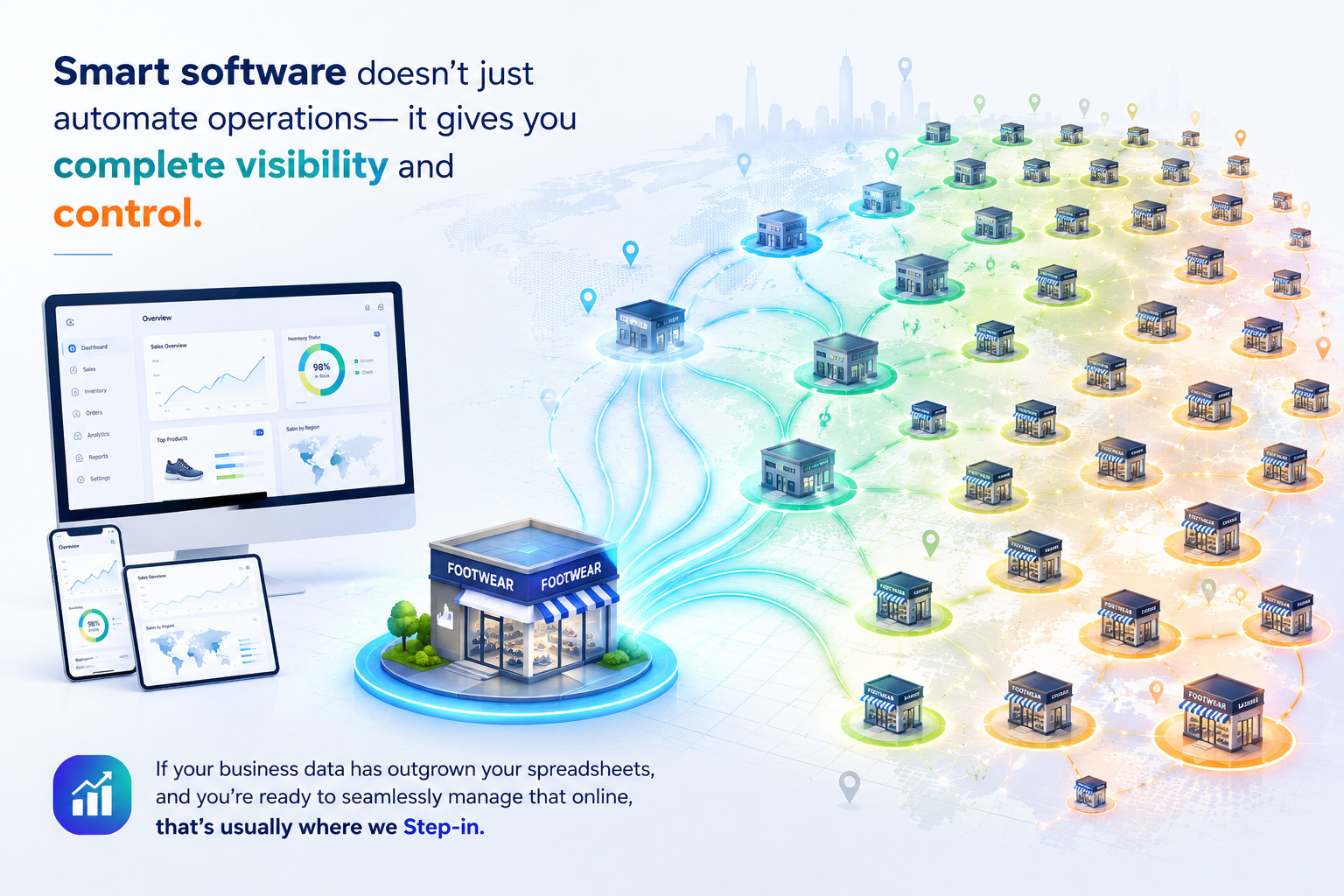
They wanted to establish a brand capable of operating across multiple cities and states through a centralized digital platform.
While they thoroughly understood paper quality, printing techniques, finishing methods, die-cutting, production scheduling, packaging, and delivery logistics, software architecture was an entirely different domain.
They already envisioned an online ordering portal but had countless unanswered questions:
- How would orders flow into production?
- Who would monitor each production stage?
- How would billing be managed?
- How would payments be reconciled?
- How could multiple branches work together?
- What reports would management require?
- How could production delays be identified instantly?
These were business questions—not programming questions.
And they deserved business-first answers.
The Challenge
Many software projects fail because development begins before understanding the business.
We intentionally followed the opposite approach.
Rather than proposing features immediately, we spent considerable time studying how Kings Printer functioned on a day-to-day basis.
We visited their printing facility.
We observed staff members processing orders.
We watched production teams move work between departments.
We documented every activity from customer enquiry to final dispatch.
We listed every product category they manufactured, including:
- Visiting Cards
- Letterheads
- Pamphlets
- Flyers
- Brochures
- Catalogues
- Stickers
- Packaging Material
- Custom Printed Items
Each product introduced dozens of configurable variables, including:
- Paper quality
- GSM
- Size
- Orientation
- Colour options
- Single-sided printing
- Double-sided printing
- Special finishing
- Lamination
- UV coating
- Die-cut shapes
- Quantity
- Delivery timeline
Unlike standard e-commerce products, every order could have hundreds of unique combinations.
Capturing these combinations accurately while keeping the ordering process simple became one of the project’s biggest technical challenges.
Why Existing Methods Were Failing
The biggest surprise came when we examined their production management process.
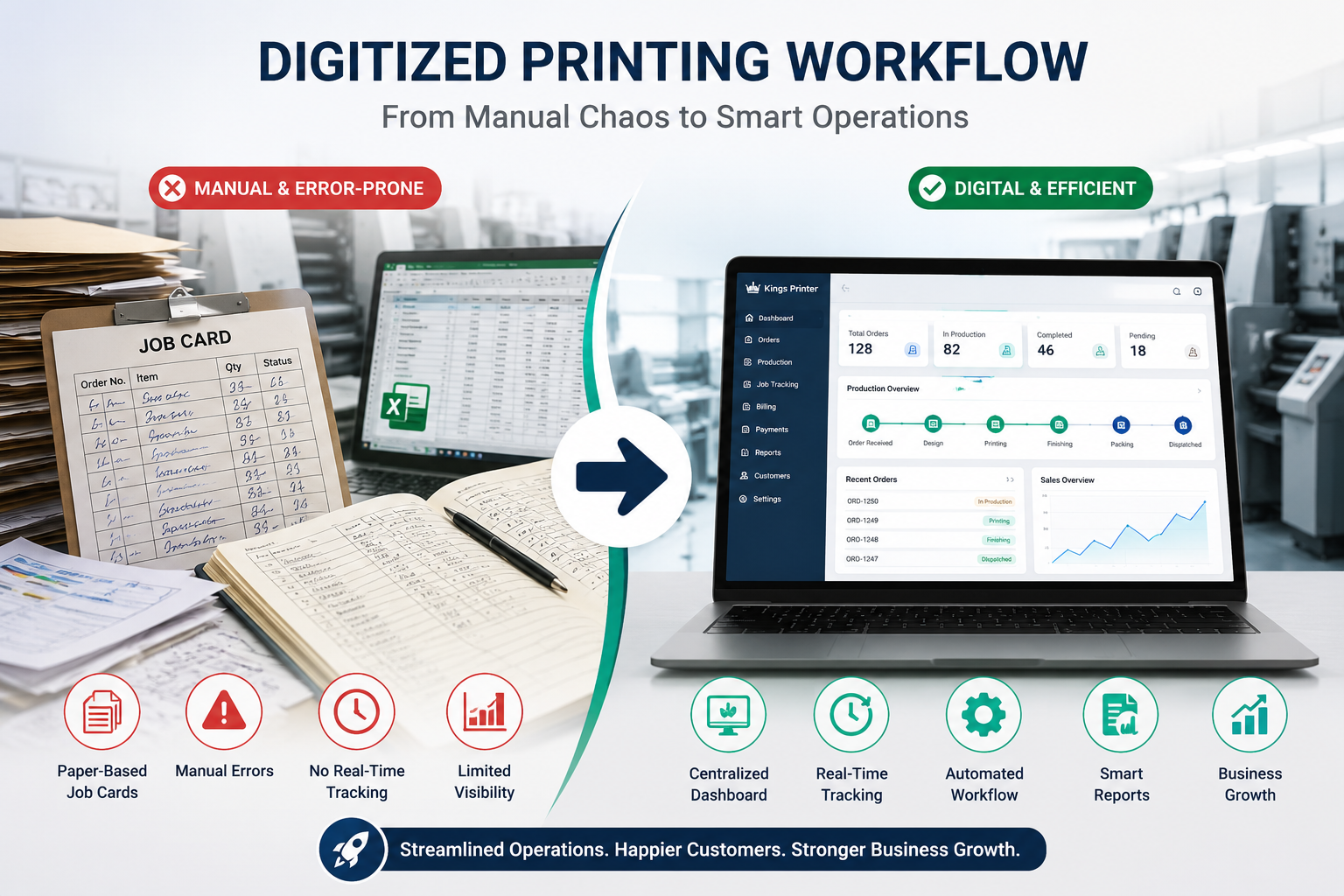
Despite being an established printing company, nearly every production activity depended upon the traditional Job Card system.
Each order was manually recorded.
Departments updated physical job cards.
Excel sheets were maintained separately.
Production supervisors relied heavily on verbal communication.
Management often had to ask multiple people before determining the actual status of an order.
Although this method had worked for years, it presented serious limitations as the business expanded.
Some of the operational risks included:
Human Errors
Handwritten job cards were occasionally difficult to interpret. Incorrect specifications could delay production or require costly reprints.
Duplicate Data Entry
The same order information was entered multiple times by different departments. This consumed valuable staff hours every day.
Limited Visibility
Management had no real-time dashboard showing work in progress. Tracking a single order often required contacting several departments.
Delayed Reporting
Generating weekly or monthly reports required manual consolidation from spreadsheets. Important business decisions were based on outdated information.
Expansion Challenges
A manual process may function adequately within one location. However, when multiple branches begin operating simultaneously, maintaining consistency becomes almost impossible.
At that moment, one thought immediately came to mind:
“This project will be challenging—but if executed correctly, it could completely transform the way this business operates.”
Our Analysis
One of the turning points arrived when Mr. Hitesh introduced us to his brother-in-law, Mr. Jetindera.
Unlike the production team, he already operated an e-commerce business and understood digital workflows.
Suddenly, conversations became much more productive.
Instead of discussing software screens, we discussed business logic.
We conducted multiple brainstorming sessions involving various business scenarios.
Questions emerged continuously.
- What happens if a customer changes artwork after approval?
- How should urgent orders be prioritised?
- Can production start before payment?
- What if multiple branches process different parts of the same order?
- How should partial dispatches be recorded?
- Which reports would branch managers require?
- How would the head office monitor production across locations?
Every question produced several possible answers.
Each answer affected another process.
Instead of rushing development, we carefully documented every workflow, exception, and dependency.
Several iterations of flowcharts were created before writing even a single line of code.
This planning phase ultimately became the strongest foundation of the project.
Solution We Proposed
Rather than developing a generic ERP or modifying existing software, we recommended a fully customized production management system designed specifically around the client’s operations.
- The objective was not merely digitization.
- It was operational standardization.
- Every department would work within the same centralized platform.
- Order information would be entered once.
- Each department would receive only the information relevant to its role.
- Production progress would update in real time.
- Management could monitor the complete workflow without interrupting employees.
The proposed solution included centralized modules for:
- Customer management
- Product configuration
- Dynamic pricing
- Order management
- Production tracking
- Department-wise workflow
- Billing
- Payment tracking
- Dispatch management
- Administrative reporting
- Multi-location operations
Instead of replacing employees, the software became their operational assistant—reducing repetitive work while improving coordination across teams.
Technology Used
Selecting the right technology stack was equally important because the software was expected to support continuous business growth.
We developed the application using:
- PHP 8.1
- MySQL
- jQuery
- AJAX
- HTML5
- CSS3
- JavaScript
The backend architecture focused on speed, stability, maintainability, and future scalability.
Development required approximately two months, followed by nearly fifteen days of intensive testing, real-world simulations, user feedback, and bug fixing before deployment.
Rather than relying on inexpensive shared hosting, we deployed the application on a self-managed dedicated server to ensure consistent performance, security, and complete control over the infrastructure.
This decision continues to benefit the client today by providing faster response times and greater operational reliability.
Features Implemented
Every feature addressed a real operational challenge rather than being added simply because it looked impressive.
Some of the major modules included:
Centralized Order Processing
Every order entered the system once and automatically flowed through the required production stages.
Product Variant Management
Complex printing configurations—including paper type, GSM, dimensions, finishing options, colours, and die-cut variations—could be managed without manual calculations.
Real-Time Production Tracking
Management gained complete visibility into every active order, eliminating dependency on physical job cards.
Department-Based Workflow
Each department viewed only the tasks assigned to them, reducing confusion and improving accountability.
Billing & Payment Management
Invoices, payment status, and customer records remained synchronized within a single system.
Reporting Dashboard
Business owners could instantly review production statistics, pending orders, completed jobs, billing performance, and operational trends.
Multi-Location Readiness
The platform was designed from the beginning to support expansion across multiple cities without changing the underlying workflow.
Business Results
More than two years have passed since the successful implementation. The results validate the importance of careful planning before development.
Kings Printer has successfully expanded beyond Rajasthan into multiple states, including:
- Madhya Pradesh
- Haryana
- Punjab
- Gujarat
- Delhi
- Additional operational regions
Although business expansion depends upon several factors—including leadership, market demand, and execution—the availability of a standardized digital workflow provided the operational foundation necessary for scaling confidently.
Instead of relying on fragmented spreadsheets and manual coordination, the company now operates with greater consistency, better visibility, and significantly improved process control.
Perhaps the most rewarding outcome is not simply the software itself.
It is the confidence that management now has in its operations.
Lessons Learned
Every custom software project teaches valuable lessons.
This project reinforced several principles we continue to follow today.
First, businesses should never begin development without thoroughly understanding their own workflows.
Second, software should adapt to the business—not force the business to adapt unnecessarily.
Third, investing time in planning often saves months of redevelopment later.
Fourth, real digital transformation begins by understanding operational problems rather than technology trends.
Finally, successful software is measured not by the number of features it contains, but by the business outcomes it enables.
How Similar Businesses Can Benefit
Although this project focused on a printing company, the underlying principles apply to countless industries.
Manufacturers, packaging companies, signage businesses, textile units, fabrication workshops, commercial printers, promotional product suppliers, and production-based SMEs often encounter similar operational challenges.
If your organization still depends on paper registers, spreadsheets, WhatsApp messages, or disconnected systems to manage production, there is a strong possibility that technology can simplify your operations significantly.
However, the right starting point is not software.
It is a consultation.
Understanding existing workflows, identifying bottlenecks, documenting business logic, and designing scalable processes are the foundations of every successful digital transformation.
Technology is merely a tool. The real value lies in creating systems that enable businesses to grow with confidence.
At RiAcube Software Hub, this philosophy has guided our work across numerous custom development projects over the years. Every successful implementation reinforces the same belief: thoughtful planning, practical engineering, and close collaboration with clients consistently deliver stronger long-term business outcomes than rushing into development.
For businesses planning expansion, investing in expert consultation before writing the first line of code can often be the single most valuable decision they make.
Frequently Asked Questions
1. Why do printing businesses need custom software instead of generic ERP solutions?
Printing businesses deal with highly configurable products, varying paper types, sizes, finishing options, production stages, and customer-specific requirements. Custom software is designed around these unique workflows, making operations more efficient than generic ERP systems.
2. What problems does a printing production management system solve?
It centralizes order processing, reduces manual errors, tracks production in real time, manages billing, improves communication between departments, and provides management with complete operational visibility.
3. Can custom software support multiple printing branches?
Yes. A properly designed system can allow multiple branches across different cities or states to work on a centralized platform while maintaining standardized workflows and reporting.
4. How long does it take to develop custom printing management software?
The timeline depends on business complexity. Most medium-sized printing management systems require 2–4 months for development, followed by testing, user training, and deployment.
5. Is custom software scalable for future business expansion?
Yes. One of the biggest advantages of custom development is that new modules, branches, products, and workflows can be added as the business grows.
6. Can existing manual workflows be digitized without disrupting operations?
Absolutely. The best approach is to understand current business processes first and then build software that improves them instead of forcing employees to adopt completely unfamiliar workflows.
7. Which technologies are suitable for developing production management software?
Modern applications are commonly built using technologies like PHP 8.x, MySQL, JavaScript, AJAX, HTML5, CSS3, and secure server infrastructure depending on project requirements.
8. Does production tracking software reduce manual errors?
Yes. By eliminating repeated data entry and replacing handwritten job cards with centralized digital records, businesses can significantly reduce production mistakes.
9. What reports should a printing management system provide?
Useful reports include order status, production progress, billing, payments, dispatches, pending jobs, department productivity, customer history, and business performance dashboards.
10. Is a dedicated server better than shared hosting for business applications?
For mission-critical production software, dedicated or cloud-managed servers generally provide better performance, security, reliability, and scalability than shared hosting.
11. What should businesses do before starting custom software development?
They should first analyze their existing workflows, identify operational bottlenecks, define long-term business goals, and work with an experienced software consultant to prepare a detailed project roadmap.
12. Can custom software integrate with future eCommerce or customer portals?
Yes. A well-architected custom application can later integrate with eCommerce websites, CRM systems, payment gateways, mobile applications, and third-party APIs.