
Choosing the right cloud infrastructure has become one of the most important technology decisions for modern businesses. Whether you’re hosting a simple website, running an enterprise ERP, building SaaS software, deploying AI workloads, or serving millions of users globally, your cloud provider directly impacts performance, uptime, scalability, and long-term operating costs.
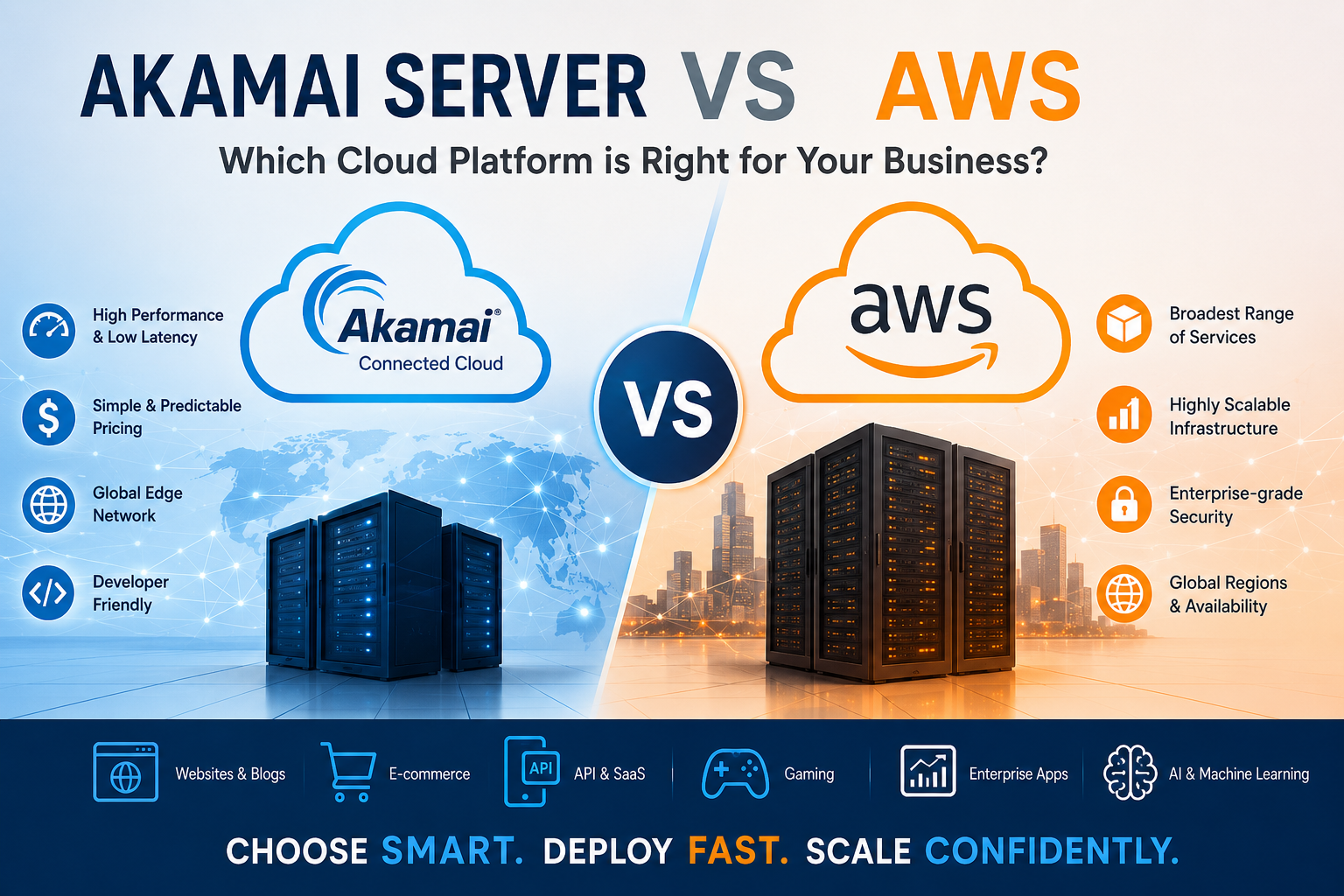
Among today’s leading cloud infrastructure providers, Amazon Web Services (AWS) and Akamai Connected Cloud (formerly Linode) are two popular choices. While both offer virtual servers, networking, storage, and cloud services, they target different business needs and workloads.
This guide compares Akamai Server vs AWS using industry trends, technical capabilities, pricing models, and practical deployment scenarios to help businesses make the right decision.
Understanding the Platforms
Amazon Web Services (AWS)
AWS is the world’s largest cloud computing platform with hundreds of managed services including:
- EC2 Virtual Servers
- RDS Databases
- Lambda Serverless
- S3 Storage
- EKS Kubernetes
- AI & Machine Learning
- Data Analytics
- IoT
- Global CDN (CloudFront)
AWS serves startups, Fortune 500 companies, governments, healthcare organizations, and enterprises across virtually every industry.
Akamai Connected Cloud
Akamai acquired Linode in 2022 and rebranded it as Akamai Connected Cloud.
The platform focuses on:
- High-performance virtual servers
- Kubernetes
- Object Storage
- Managed Databases
- Edge Computing
- Developer-friendly cloud
- Simple pricing
- Excellent networking performance
Akamai also owns one of the world’s largest Content Delivery Networks (CDNs), making it particularly strong in low-latency content delivery.
Market Position
| Feature | AWS | Akamai |
|---|---|---|
| Market Share | Largest global cloud provider | Growing developer-focused cloud |
| Availability Regions | 35+ Regions | 25+ Global Locations |
| Edge Network | Excellent | Industry-leading CDN |
| Services | 250+ | Focused cloud portfolio |
| Complexity | High | Low |
| Learning Curve | Steep | Beginner Friendly |
Performance Comparison
AWS Performance
AWS excels in:
- High-performance computing
- AI training
- Large databases
- Massive enterprise applications
- Auto scaling
- Global redundancy
It offers virtually unlimited scaling capabilities.
Ideal for:
- Netflix-style applications
- Banking platforms
- Healthcare systems
- ERP software
- Enterprise SaaS
Akamai Performance
Akamai performs exceptionally well for:
- Website hosting
- APIs
- Kubernetes workloads
- Edge applications
- Gaming
- CDN-heavy websites
- Developer environments
Its networking latency is often lower due to Akamai’s massive global edge infrastructure.
Pricing Comparison
One of the biggest differences lies in pricing.
AWS
AWS follows a pay-as-you-go pricing model.
Advantages:
- Flexible
- Hundreds of configuration choices
- Enterprise discounts
Disadvantages:
- Billing complexity
- Unexpected charges
- Separate networking costs
- Separate storage costs
Many startups struggle to predict AWS monthly bills.
Akamai
Akamai provides simple and transparent pricing.
Typically includes:
- Fixed monthly cost
- Included bandwidth
- Predictable invoices
- Easier budgeting
This makes it attractive for SMBs and startups.
Ease of Use
AWS
AWS Console is extremely powerful.
However, beginners often find it overwhelming because of:
- Hundreds of services
- Complex IAM permissions
- Networking configuration
- VPC management
- Security policies
Learning AWS requires time and experience.
Akamai
Akamai focuses on simplicity.
Developers can launch cloud servers in minutes.
Its dashboard is clean, intuitive, and much easier for:
- Developers
- Agencies
- Small businesses
- Startups
Security
Both platforms provide enterprise-grade security.
AWS
Offers:
- IAM
- Shield
- GuardDuty
- WAF
- KMS
- CloudTrail
- Security Hub
Ideal for highly regulated industries.
Akamai
Leverages decades of cybersecurity expertise through:
- Global DDoS mitigation
- Web Application Firewall
- Edge security
- CDN protection
- Secure networking
For websites exposed to internet traffic, Akamai’s security capabilities are among the industry’s strongest.
Scalability
AWS is virtually unmatched when applications require:
- Thousands of servers
- AI clusters
- GPU farms
- Petabyte storage
- Global multi-region deployment
Akamai scales well for most business workloads but isn’t designed to match AWS’s breadth of hyperscale managed services.
Best Applications for AWS
AWS is the preferred choice for:
- Enterprise ERP
- Banking applications
- AI & Machine Learning
- Big Data Analytics
- Enterprise SaaS
- Government projects
- Healthcare systems
- High-volume APIs
- IoT Platforms
- Financial Applications
Best Applications for Akamai
Akamai is ideal for:
- WordPress Hosting
- Business Websites
- E-commerce Stores
- Agency Hosting
- Developer Projects
- Kubernetes Deployments
- SaaS MVPs
- Gaming Servers
- API Hosting
- Edge Applications
- CDN-heavy websites
Which Platform Should You Choose?
Choose AWS if:
- You need enterprise-scale infrastructure.
- Your application requires advanced managed services.
- You’re building AI, analytics, or large SaaS platforms.
- You expect rapid, global scaling.
- Compliance and extensive cloud-native tooling are critical.
Choose Akamai if:
- You want predictable pricing.
- You need fast website or API hosting.
- Your workload benefits from edge delivery.
- You’re a startup, SMB, agency, or independent developer.
- You value simplicity over an extensive service catalog.
RiAcube’s Recommendation
At RiAcube Software Hub, we generally recommend selecting the cloud platform based on business goals rather than brand popularity.
- Choose Akamai Connected Cloud for small to medium business websites, web applications, e-commerce platforms, APIs, and cost-conscious SaaS projects where predictable pricing and low-latency delivery are priorities.
- Choose AWS for enterprise-grade applications, AI/ML projects, highly regulated workloads, and systems requiring a broad ecosystem of managed services.
Many modern organizations also adopt a hybrid approach, running applications on AWS while using Akamai’s edge network and security services to improve performance and resilience.
Conclusion
There is no universal winner in the Akamai Server vs AWS debate.
AWS remains the industry leader for enterprises seeking the broadest range of cloud services and virtually limitless scalability. Akamai Connected Cloud, on the other hand, offers an attractive combination of simplicity, transparent pricing, strong networking, and excellent edge performance that appeals to startups, agencies, and growing businesses.
The best cloud platform is the one that aligns with your application’s architecture, performance goals, budget, and long-term growth strategy.
FAQs
1. Is Akamai cheaper than AWS?
Yes. Akamai Connected Cloud generally offers simpler and more predictable pricing, making it easier for startups and small businesses to estimate monthly costs.
2. Is AWS better than Akamai?
AWS is better for enterprise workloads, AI, analytics, and large-scale cloud applications, while Akamai is often preferred for web hosting, APIs, edge computing, and developer-friendly deployments.
3. Which platform is better for WordPress hosting?
Akamai Connected Cloud is frequently chosen for WordPress hosting because of its straightforward pricing, strong networking performance, and ease of management.
4. Can businesses migrate from AWS to Akamai?
Yes. Many organizations migrate selected workloads to Akamai to reduce costs or improve edge performance while retaining enterprise applications on AWS.
5. Which cloud platform is better for AI applications?
AWS offers a far more extensive ecosystem for AI and machine learning, including GPU instances, SageMaker, Bedrock, and advanced analytics services.
6. Does Akamai provide Kubernetes?
Yes. Akamai Connected Cloud supports managed Kubernetes for deploying scalable containerized applications.
7. Which platform offers better global networking?
Both provide excellent networking, but Akamai’s extensive edge network is particularly effective for low-latency content delivery and DDoS protection.
8. Is AWS suitable for startups?
Yes, especially startups expecting rapid growth, though careful cost management is important due to AWS’s consumption-based pricing model.
9. Which cloud is easier to learn?
Akamai Connected Cloud generally has a shorter learning curve, while AWS requires more time because of its large portfolio of services.
10. Which cloud provider does RiAcube recommend?
RiAcube recommends selecting the platform based on project requirements. Akamai is ideal for many SMB and web workloads, while AWS is better suited for enterprise-scale applications and advanced cloud-native architectures.